Install
One-liner install on every machine. Works on Linux, macOS, and WSL2.
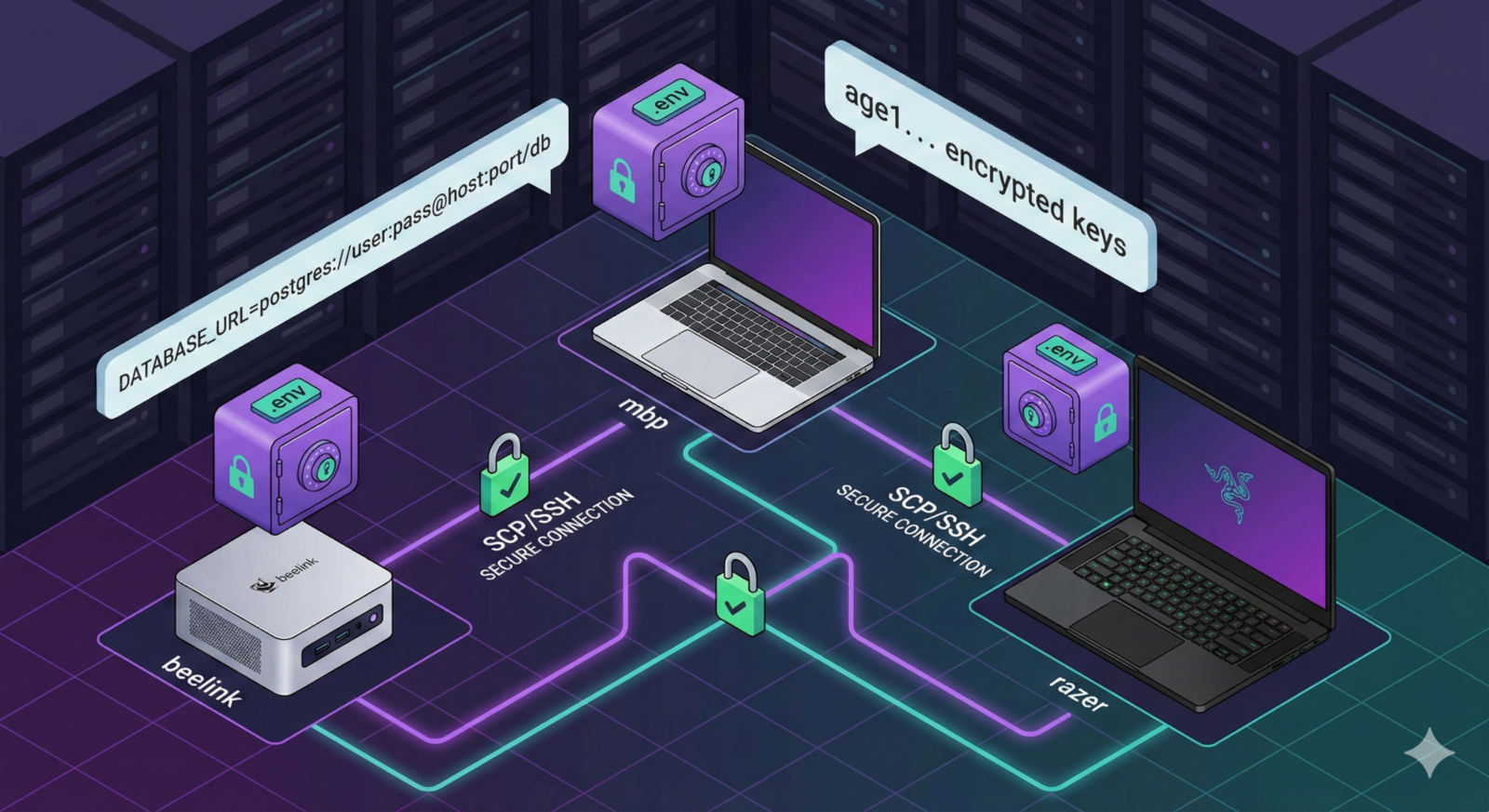
env-sync keeps secrets in sync across every machine on your local network — automatically. No central server, no cloud dependency, no manual copy-paste.
Open Source mDNS Auto-Discovery SSH & mTLS Transport AGE Encryption
# install in 10 seconds
curl -fsSL https://envsync.arnav.tech/install.sh | bash -s -- --user

# start syncing
env-sync init
env-sync add OPENAI_API_KEY="sk-..."
env-sync syncNo accounts to create, no servers to manage, no cloud services to configure.
One-liner install on every machine. Works on Linux, macOS, and WSL2.
Run env-sync init to set up keys and choose your security mode.
Peers discover each other via mDNS. Secrets merge automatically with backups.
Unlike cloud-based secret managers, env-sync works entirely on your local network — even without an internet connection.
Machines find each other automatically using Avahi or Bonjour. No manual IP configuration needed.
From zero-config SSH for personal devices to mTLS + AGE encryption for cross-team collaboration.
Per-key timestamps prevent data loss. Automatic backups before every write — keeps last 5 versions.
Single Go binary. No runtime dependencies, no background database, no Docker required.
Cron-based sync every 30 minutes, shell hook on startup, or manual trigger — your choice.
Invite, approve, and revoke peers with signed membership events that propagate automatically.
env-sync gives you explicit control over trust boundaries. Pick the mode that fits your team.
| Mode | Storage | Transport | Best for |
|---|---|---|---|
| trusted-owner-ssh (default) | Plaintext (optional AGE) | SCP / SSH | All machines belong to you — your laptop, desktop, NUC, server |
| secure-peer | AGE encrypted (mandatory) | HTTPS + mTLS | Multiple people sharing secrets without giving each other shell access |
| dev-plaintext-http | Plaintext | HTTP | Quick local debugging only — not for real secrets |
env-sync fills the gap that centralized tools leave open — secrets on local machines that drift apart.
Enterprise secrets platform vs lightweight peer sync.
Open-source secrets platform vs decentralized LAN mesh.
Cloud secrets operations vs offline-first sync.
Encrypted dotenv runtime injection vs peer synchronization.
Git-native encrypted files vs always-on machine sync.